
Manufacturers are investing heavily in digital transformation, automation, and real-time production visibility. But many mid-sized discrete manufacturers still end up frustrated after implementing MES software.
Why?
Because many MES platforms only solve part of the problem.
They may provide machine monitoring dashboards or basic production tracking, but they often fail to support the deeper operational workflows that discrete manufacturers rely on every day.
A true discrete manufacturing MES should do far more than collect machine data. It should connect ERP planning, shop floor execution, inventory movement, labor tracking, scheduling, quality management, and production visibility into a single operational system.
That’s where many generic MES platforms fall short.
MV2 MES was built specifically for discrete manufacturers that need deeper operational visibility and tighter integration between the ERP system and the shop floor.
Why Do Generic MES Solutions Fail Discrete Manufacturers?
Generic MES solutions often fail discrete manufacturers because they focus primarily on machine monitoring and high-level dashboards rather than full production execution. Discrete manufacturers require MES software that supports ERP integration, labor tracking, scheduling, inventory movement, quality management, traceability, and real-time shop floor execution across complex manufacturing workflows.
Many manufacturers eventually realize they purchased a machine monitoring platform instead of a true manufacturing execution system.
Visibility alone doesn’t improve manufacturing performance. Execution does.
The Problem With “One-Size-Fits-All” MES Platforms
Many MES vendors position their software as flexible enough for every manufacturing environment.
But most generic MES platforms were originally designed around narrower use cases like:
- Machine monitoring
- OEE reporting
- Downtime tracking
- Data collection
- Equipment dashboards
Those capabilities matter, but they only address a fraction of what discrete manufacturers actually manage throughout production.
A discrete manufacturing MES needs to support much deeper operational processes, including:
- Multi-step routing workflows
- Labor tracking
- Inventory movement
- Material staging
- Scheduling feedback
- Engineering revisions
- Quality inspections
- Serialized or lot traceability
- ERP synchronization
Without those capabilities, manufacturers often end up creating manual workarounds outside the MES system.
That leads to disconnected data, inconsistent reporting, and limited operational control.
Manufacturers evaluating MES software should first understand the difference between machine monitoring and full manufacturing execution.
Visibility Alone Doesn’t Solve Production Problems
One of the biggest misconceptions in manufacturing technology is that more visibility automatically improves operations.
It doesn’t.
A dashboard may tell you a machine stopped running, but that’s only one small piece of the operational picture.
Manufacturers also need to know:
- Why production stopped
- Whether the material is available
- Which jobs are impacted
- Whether quality inspections passed
- If labor were reassigned
- How schedules are affected downstream
- Whether ERP production data is still accurate
This is where many lightweight MES platforms struggle.
They provide visibility into equipment activity but leave manufacturers manually connecting operational workflows across separate systems.
That creates gaps between:
- The ERP and the shop floor
- Production and inventory
- Operators and supervisors
- Scheduling and execution
MV2 MES was designed to eliminate those disconnects by connecting manufacturing workflows directly to real-time shop floor execution.
Additional related reading from ISE’s Knowledge Hub:
- “MES vs. ERP: Key Differences and How MV2 Connects Them”
- “Why Copilot Still Can’t See Your Shop Floor”
Why Discrete Manufacturing Requires a Deeper MES
Discrete manufacturing environments are rarely simple.
Most manufacturers deal with:
- High product variation
- Complex assemblies
- Long production cycles
- Engineering changes
- Mixed manual and automated operations
- Cross-department coordination
- Traceability requirements
A generic MES platform often treats manufacturing like a data collection problem.
But discrete manufacturing is an execution problem.
Manufacturers don’t just need dashboards. They need systems capable of managing production as work moves through the plant.
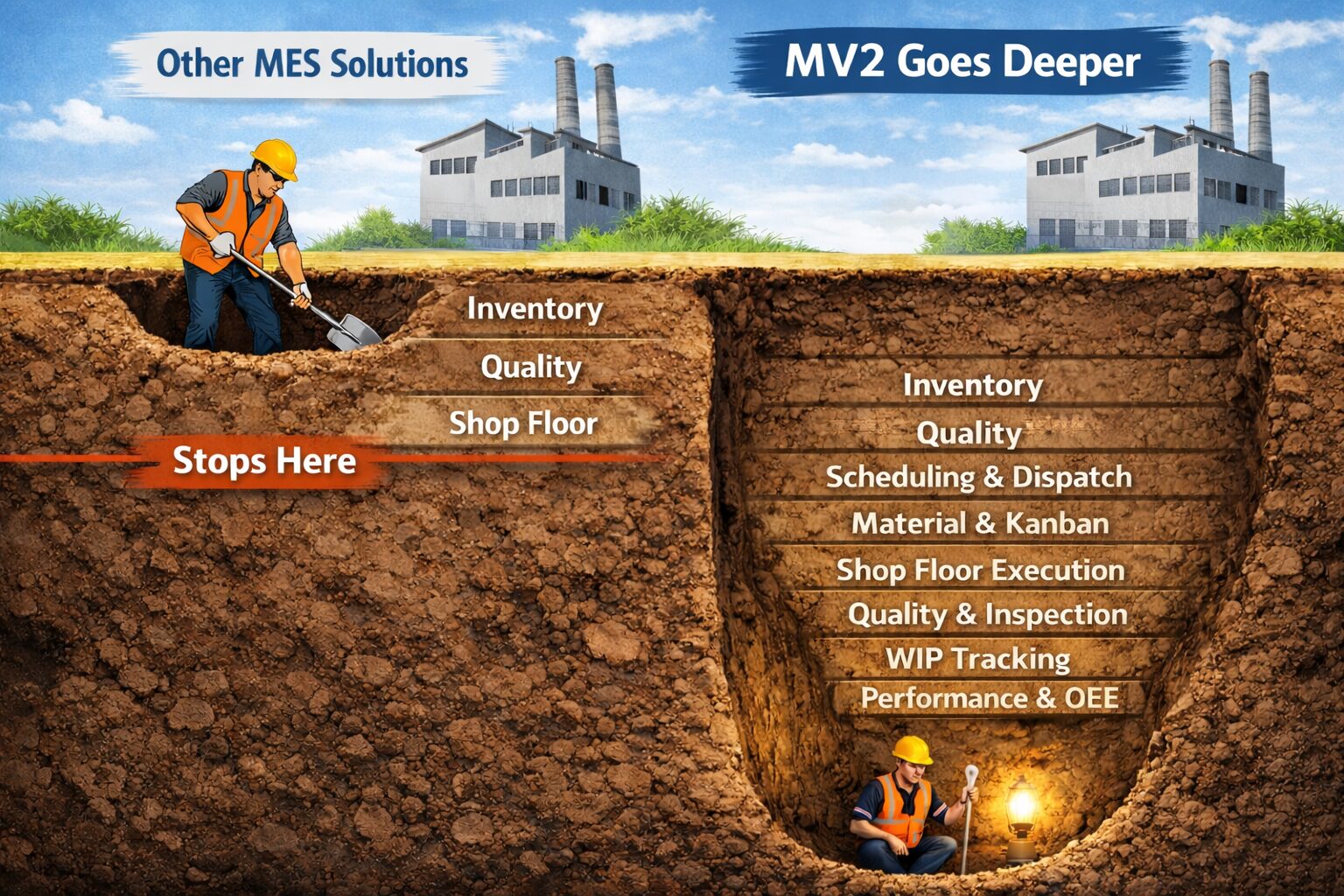
MV2 MES goes deeper by helping manufacturers manage:
- Shop floor execution
- Scheduling and dispatch
- Material and Kanban workflows
- Quality and inspection processes
- WIP tracking
- Labor transactions
- ERP integration
- Production visibility
That operational depth gives manufacturers far more control over production performance and decision-making.
Manufacturers evaluating discrete manufacturing MES software may also find these resources helpful:
The ERP Disconnect Is Where Many MES Platforms Fail
Most manufacturers already have ERP systems managing:
- Inventory
- Purchasing
- Scheduling
- Customer orders
- Financials
But many MES platforms operate separately from the ERP instead of integrating deeply with it.
That creates duplicate processes where:
- Operators enter production data into one system
- Office teams manually update ERP records later
- Inventory discrepancies grow
- Scheduling accuracy declines
- Reporting becomes unreliable
For discrete manufacturers, that disconnect creates operational chaos.
MV2 MES was built specifically to bridge the gap between ERP planning and real-time manufacturing execution.
As production occurs, information flows automatically between systems, helping manufacturers maintain accurate:
- Labor reporting
- Inventory transactions
- Work order status
- Scheduling updates
- Production quantities
For manufacturers operating in Infor XA or Dynamics 365 (F&SCM and Business Central) environments, this level of synchronization is especially important.
Generic MES vs Specialized MES for Discrete Manufacturing
While generic MES platforms may support basic production tracking, discrete manufacturers often require deeper functionality for high-mix operations, ERP integration, and real-time shop floor visibility.
Then insert the table.
Suggested version:
| Capability | Generic MES | MV2 MES for Discrete Manufacturing |
|---|---|---|
| High-mix production support | Limited | Designed for complex routing and variability |
| ERP integration | Basic or rigid | Deep integration with systems like Dynamics 365 |
| Real-time shop floor visibility | Partial | Full operational visibility |
| Labor tracking | Generic reporting | Detailed labor and machine tracking |
| Routing flexibility | Limited workflows | Configurable multi-step routing |
| Traceability | Often limited | End-to-end traceability |
| Scalability | May require customization | Built for manufacturing growth |
Many MES Platforms Stop at Machine Monitoring
Machine monitoring has become one of the fastest-growing categories in manufacturing software.
And while machine data is valuable, it’s not the same as manufacturing execution.
Many manufacturers discover that their MES platform can show machine utilization, but still cannot effectively manage:
- Work order progression
- Operator workflows
- Inventory movement
- Production routing
- Quality inspections
- Scheduling feedback
- WIP tracking
That’s why manufacturers often continue relying on spreadsheets, whiteboards, and manual updates even after implementing MES software.
MV2 MES was built to go beyond machine monitoring by supporting the full production lifecycle across the shop floor.
That deeper operational functionality is what helps manufacturers move from visibility to actual process control.
Operator Adoption Is Often Overlooked
Another major reason MES projects fail is usability.
Some MES systems are designed primarily for analysts or engineers rather than manufacturing operators.
The result is often:
- Complex interfaces
- Excessive data entry
- Poor workflow alignment
- Low operator adoption
And when operators avoid the system, data quality suffers immediately.
MV2 MES was designed around real manufacturing workflows with:
- Touchscreen-friendly interfaces
- Barcode scanning
- Digital work instructions
- Mobile accessibility
- Simplified labor reporting
- Role-based dashboards
Ease of use matters because even the most advanced MES platform fails if production teams work around it.
Additional reading:
Why Mid-Sized Manufacturers Need a Different MES Approach
Many MES platforms were originally built for:
- Enterprise automotive plants
- Semiconductor facilities
- Highly automated operations
Mid-sized discrete manufacturers often operate very differently.
They need MES software flexible enough to support:
- High-mix production
- Manual workflows
- Evolving production processes
- Limited IT resources
- Faster implementation timelines
That’s why MV2 MES focuses specifically on the operational realities of mid-sized discrete manufacturing environments.
ISE brings decades of manufacturing experience to implementations, helping manufacturers solve operational problems, not just deploy software.
MV2 MES Goes Deeper Where It Matters
Manufacturers don’t need another disconnected dashboard.
They need a discrete manufacturing MES capable of connecting:
- ERP planning
- Shop floor execution
- Inventory movement
- Labor tracking
- Quality management
- Scheduling
- Production visibility
into a single operational ecosystem.
That’s where many generic MES platforms fall short.
MV2 MES goes deeper by helping manufacturers:
- Eliminate manual workarounds
- Improve production visibility
- Synchronize ERP and shop floor data
- Improve traceability
- Increase operator accountability
- Reduce production delays
- Support continuous improvement initiatives
For discrete manufacturers, MES success depends on more than machine data alone. It requires deeper operational control across the entire manufacturing process.
Learn more about MV2 MES here: MV2 MES
FAQs About MES for Discrete Manufacturing
What is a discrete manufacturing MES?
A discrete manufacturing MES is a manufacturing execution system designed to manage production workflows for manufacturers producing distinct products like industrial equipment, fabricated components, aerospace parts, or assemblies. These systems support production tracking, ERP integration, scheduling, quality management, labor reporting, and traceability.
Why do generic MES systems fail discrete manufacturers?
Many generic MES systems focus mainly on machine monitoring and reporting instead of full shop floor execution. Discrete manufacturers require deeper operational functionality, including inventory tracking, routing management, labor reporting, scheduling integration, and quality workflows.
What is the difference between machine monitoring and MES?
Machine monitoring tracks equipment activity such as uptime, downtime, and utilization. A true MES manages broader manufacturing operations, including work orders, labor, materials, scheduling, inventory movement, quality inspections, and ERP synchronization.
Why is ERP integration important for MES?
ERP integration helps synchronize production activity with inventory, scheduling, labor reporting, and work order management. Without integration, manufacturers often rely on manual updates and disconnected systems that reduce visibility and data accuracy.
What industries benefit most from MV2 MES?
MV2 MES is designed for mid-sized discrete manufacturers, including:
- Industrial equipment manufacturers
- Fabricated metal manufacturers
- Aerospace manufacturers
- Engineered-to-order operations
- High-mix, low-volume manufacturing environments
Final Thoughts
Not all MES systems are built for discrete manufacturing.
Many platforms provide dashboards and machine visibility, but manufacturers often discover that those tools don’t fully support the operational complexity of real production environments.
The manufacturers seeing the strongest MES results are the ones investing in systems designed specifically for:
- Shop floor execution
- ERP integration
- Production workflows
- Real-time operational visibility
- Manufacturing process control
MV2 MES was built with those realities in mind.
Because for discrete manufacturers, visibility alone isn’t enough. Manufacturers also need operational depth, execution control, and real-time coordination across the entire shop floor.
To explore how MV2 MES helps manufacturers bridge the gap between ERP planning and shop floor execution, visit: https://www.iseteam.com/contact