
ERP is entering a new era, one where systems don’t just record transactions, but act on them.
Across the market, vendors are introducing AI-driven capabilities that promise more autonomy:
- Creating and processing orders
- Recommending next steps
- Automating workflows across departments
- Triggering actions based on exceptions instead of waiting for user input
This shift is being positioned as the next evolution of ERP, moving from passive systems of record to active systems of decision-making.
On paper, it’s a major leap forward.
But for manufacturers, especially those with complex, high-mix production environments, there’s a critical question that often gets overlooked:
What happens when production changes?
Because in manufacturing, it always does.
The Promise of Autonomous ERP
The concept of autonomous ERP is compelling, and in many areas of the business, it delivers real value.
Instead of relying on manual inputs and reactive processes, modern ERP systems can:
- Identify potential delays before they impact delivery
- Recommend corrective actions based on historical patterns
- Automatically execute routine decisions like order releases or rescheduling
In structured environments like finance, procurement, or order management, this works well. These processes are:
- Predictable
- Rules-based
- Driven by consistent, well-maintained data
That’s why automation has already made significant progress in these areas.
However, manufacturing introduces a different level of complexity.
Production is not just a series of transactions; it’s a dynamic, constantly shifting environment. And while ERP is excellent at planning and tracking, it was never designed to capture the realities of execution on the shop floor fully.
For a deeper look at where ERP planning breaks down in manufacturing, explore ISE’s knowledge hub: https://www.iseteam.com/resources/mes-vs-erp-key-differences-and-how-mv2-connects-them/
Manufacturing Isn’t Predictable
On the shop floor, change isn’t the exception; it’s the baseline.
Throughout the day, manufacturers deal with:
- Machine downtime that disrupts entire schedules
- Rush orders that override planned priorities
- Material shortages that force last-minute substitutions
- Labor constraints that shift capacity in real time
These variables introduce constant disruption to even the most carefully planned schedules.
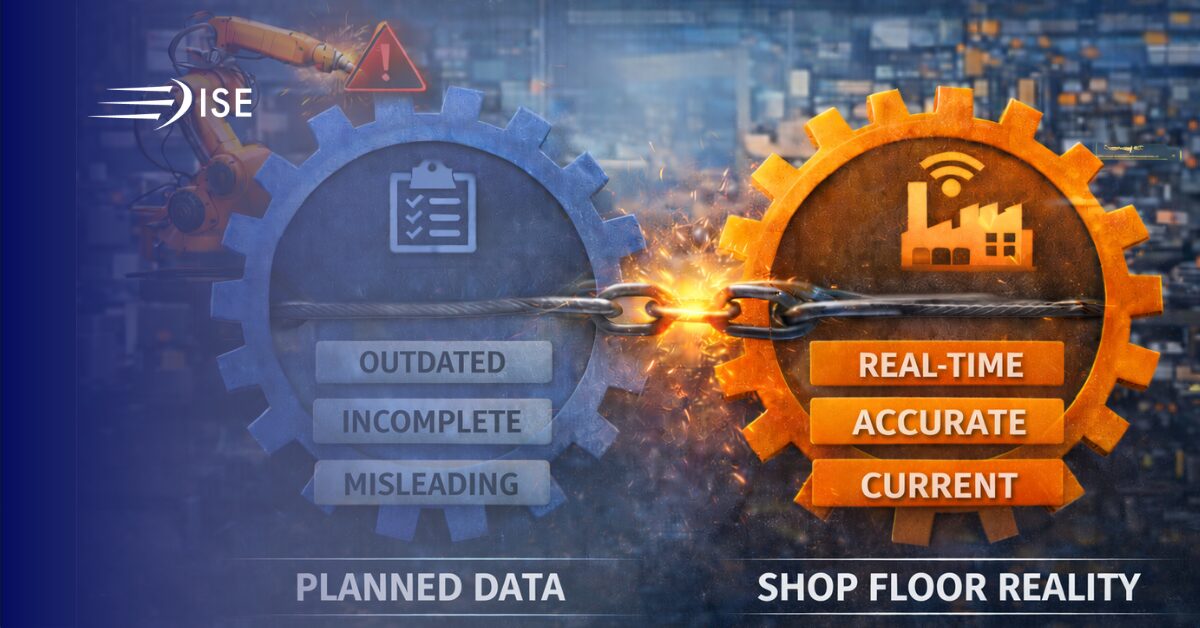
ERP systems, however, are built around planned data:
- Routings that assume consistent cycle times
- Bills of material that assume material availability
- Production schedules that assume everything goes as expected
But what actually happens on the shop floor rarely aligns with those assumptions.
This gap between planning and execution is one of the most common challenges manufacturers face. Without real-time insight into what’s actually happening, ERP systems are always a step behind.
Where Autonomous ERP Breaks Down
Autonomous ERP depends on one thing above all else:
Accurate, real-time data.
Without it, automation doesn’t just lose effectiveness, it introduces risk.
Let’s look at how this plays out in real-world scenarios.
1. The Schedule That No Longer Exists
An automated system recommends adjusting production priorities based on the current schedule.
But the schedule changed hours ago due to a machine failure, and that update hasn’t been reflected in ERP.
The system is making decisions based on a version of reality that no longer exists.
2. The Routing That Was Never Accurate
Autonomous systems rely heavily on standard routings to estimate time, capacity, and resource allocation.
But in many environments, actual production times vary significantly from estimates.
When those inaccuracies exist, automation doesn’t correct them; it scales them.
3. The Bottleneck No One Can See
ERP can flag that an order is delayed, but it often cannot identify why.
Is it a machine constraint? A labor issue? A queue buildup at a specific work center?
Without visibility into the shop floor, automated decisions lack context, and context is everything in manufacturing.
These challenges are often rooted in a lack of real-time data collection.
Automation Without Visibility Is Just Guessing
Autonomous ERP is only as strong as the data behind it.
And in manufacturing, the biggest gap isn’t automation, it’s visibility.
Many manufacturers still rely on:
- Manual data entry at the end of shifts
- Paper-based tracking systems
- Disconnected tools that don’t integrate with ERP
- Delayed updates that don’t reflect current conditions
This creates a fundamental disconnect:
- ERP reflects what should be happening
- The shop floor reflects what is happening
Autonomous ERP operates between these two realities. Without alignment, it’s making decisions based on incomplete or outdated information.
Visibility isn’t just a reporting issue. It’s a decision-making issue.
The Missing Layer: Shop Floor Execution
To make autonomous ERP effective in manufacturing, there needs to be a bridge between planning and execution.
That bridge is a Manufacturing Execution System (MES).
An MES connects ERP to the shop floor by:
- Capturing real-time production data directly from operators and machines
- Tracking actual labor and machine activity as it happens
- Providing immediate visibility into work in progress
- Feeding accurate data back into ERP systems
With this layer in place:
- ERP is no longer operating on assumptions
- Automated recommendations are grounded in real-world conditions
- Production decisions can adapt dynamically as changes occur
Without this connection, ERP remains a planning tool, no matter how advanced its automation becomes.
From Autonomous ERP to Informed Automation
The goal isn’t to eliminate automation, it’s to make it meaningful.
For manufacturers, that means:
- Aligning ERP data with actual shop floor activity
- Ensuring decisions are based on current conditions, not outdated plans
- Providing the context needed for system-driven actions to be effective
Autonomous ERP has the potential to transform how businesses operate.
But in manufacturing, autonomy without visibility leads to misalignment, and misalignment leads to inefficiency.
When real-time execution data is introduced, automation becomes:
- More accurate
- More reliable
- More valuable
The Bottom Line
Autonomous ERP sounds great until production changes.
And production always changes.
Manufacturers don’t need more automation based on static plans. They need systems that reflect what’s actually happening on the shop floor, moment by moment.
Better decisions don’t come from more automation alone.
They come from better visibility, connected systems, and real-time insight.
ISE helps manufacturers bridge the gap between ERP and the shop floor—so automation works the way it’s supposed to.
Frequently Asked Questions
What is autonomous ERP?
Autonomous ERP refers to ERP systems that use AI and automation to make decisions, recommend actions, and execute workflows with minimal human input. These systems are designed to improve efficiency by reducing manual tasks and responding to business events in real time.
Why does autonomous ERP fail in manufacturing?
Autonomous ERP struggles in manufacturing because it relies on planned data, such as schedules and routings, that often don’t reflect real-time shop-floor conditions. When production changes and ERP isn’t updated immediately, automated decisions are based on outdated or incomplete information.
What is the biggest challenge with ERP automation in manufacturing?
The biggest challenge is a lack of real-time visibility. Without accurate, up-to-date data from the shop floor, ERP systems can’t make reliable decisions. Automation without visibility leads to misalignment between planning and execution.
Can ERP systems manage shop floor operations on their own?
No. ERP systems are designed for planning and tracking, not real-time execution. They typically lack direct visibility into machine activity, labor, and work-in-progress, which are critical for managing production effectively.
Why is shop floor visibility important for ERP automation?
Shop floor visibility ensures that ERP systems are working with accurate, current data. This allows automated decisions like scheduling changes or order prioritization to reflect what’s actually happening in production, not just what was planned.
Do manufacturers need MES with ERP?
Yes. A Manufacturing Execution System (MES) provides the real-time production data that ERP systems need. By connecting ERP to the shop floor, MES helps ensure that automation is based on actual conditions, improving accuracy and decision-making.
How can manufacturers make ERP automation more effective?
To make ERP automation effective, manufacturers need to:
- Capture real-time production data
- Connect ERP to shop floor systems
- Ensure visibility into work-in-progress
- Align planning with actual execution
With this foundation in place, automation becomes more accurate and valuable.